Juan Diego
Juan Diego Cuauhtlatoatzin
Feast Day
December 9
Nationality
Aztec / Indigenous Mexican
Canonized
2002-07-31
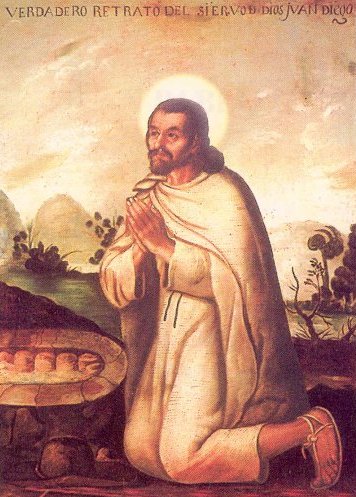
Record
Patronage
indigenous peoples of the Americas
Biography
Juan Diego Cuauhtlatoatzin was born in 1474 at Cuauhtitlan, in the Aztec empire, in the region that is now central Mexico. His birth name in Nahuatl — Cuauhtlatoatzin — has been translated as "the eagle who speaks." He was a member of the Chichimec people and lived as a farmer and mat weaver. He converted to Christianity in the early 1520s, after the Spanish conquest, and was baptized by Franciscan missionaries. He took the Christian name Juan Diego. He was among the earliest indigenous converts in New Spain. He was widowed and devoted himself to his faith, walking fifteen miles each day to attend Mass.
On December 9, 1531, while on his way to Mass at Tlatelolco, he passed the hill of Tepeyac, north of Mexico City. He heard music and saw a luminous young woman who spoke to him in Nahuatl. She identified herself as the Virgin Mary and asked him to go to Bishop Juan de Zumárraga and request that a chapel be built at Tepeyac, where she promised to show her love and compassion to all who sought her there. The bishop received Juan Diego but asked for a sign before he would act.
Mary appeared to Juan Diego again on December 12. She told him that his uncle Juan Bernardino — whom he had been trying to reach to find a priest for, believing him near death from illness — had been healed. She directed Juan Diego to the top of Tepeyac hill, where he found Castilian roses blooming out of season in the cold December earth. He gathered them in his tilma — the coarse cactus-fiber cloak worn by men of his class — and carried them to the bishop. When he opened the tilma before Zumárraga, the roses fell to the floor and the image of the Virgin was found imprinted on the cloth.
The tilma still exists. It is displayed behind glass at the Basilica of Our Lady of Guadalupe in Mexico City, which stands near the base of Tepeyac Hill. The cactus-fiber fabric has not decayed in nearly five centuries. Scientific examinations have found no evidence of brush strokes, no underdrawing, and no sizing on the fibers. It remains the most visited Marian shrine in the world.
Juan Diego spent the last seventeen years of his life in a small hut near the chapel at Tepeyac, caring for pilgrims. He died in 1548. His veneration was formally approved in 1663. He was beatified equipollently by Pope John Paul II on May 6, 1990, and canonized on July 31, 2002 — the first indigenous saint of the Americas canonized in the modern era.
Miracles (3)
Our Lady of Guadalupe
Healing of Juan José Barragán Silva
Fell ten meters headfirst from an apartment balcony onto cement. His mother, who witnessed the fall, immediately invoked Juan Diego. He lapsed into a coma and e…
The Tilma of Our Lady of Guadalupe
Mary directed Juan Diego to gather Castilian roses (out of season, unknown in Mexico) from the top of Tepeyac Hill and carry them to the bishop. When he opened …
Locations
Sources
- Reference Wikipedia ↗
- Vatican Canonization of St. Juan Diego - Vatican Liturgy Page ↗
- Reference Juan Diego - Wikipedia ↗
- Official Site Basilica of Our Lady of Guadalupe - Official Site ↗