The Tilma of Our Lady of Guadalupe
Date
1531-12-12 (exact day)
Location
Tepeyac Hill
Topics
Cure Details
Mary directed Juan Diego to gather Castilian roses (out of season, unknown in Mexico) from the top of Tepeyac Hill and carry them to the bishop. When he opened his tilma before Bishop Zumárraga, the roses fell and the image of the Virgin was found imprinted on the cactus-fiber cloth. The tilma has not decayed in nearly five centuries; scientific examination has found no brushstrokes, underdrawing, or sizing on the fibers.
Synopsis
On December 9, 1531, Juan Diego was walking near the hill of Tepeyac, north of Mexico City, on his way to Mass. He heard music and saw a luminous young woman who spoke to him in Nahuatl. She identified herself as the Virgin Mary and asked him to go to Bishop Juan de Zumárraga and request that a chapel be built at Tepeyac. Juan Diego went to the bishop. Zumárraga received him courteously but asked for a sign before he would act.
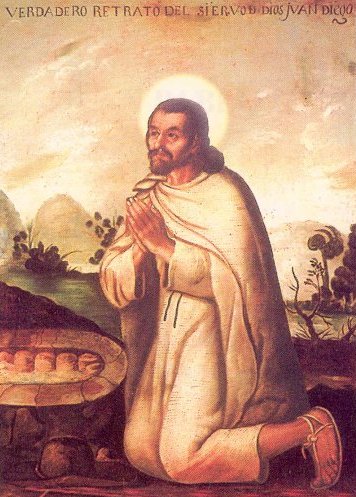
Over the following days Juan Diego returned to the hill, and Mary appeared to him again. On December 12, he set out not for the hill but for the town of Tlatelolco, intending to find a priest for his uncle Juan Bernardino, who was gravely ill and believed to be dying. He tried to avoid the hill. Mary appeared to him anyway, on a path around it, and told him that his uncle had already been healed — which was later confirmed. She directed him to the top of Tepeyac, where he found Castilian roses in bloom. These were roses native to Spain, unknown in this region of Mexico, blooming in December on a barren, frost-touched hill. He gathered them in his tilma — the coarse ayate cloak worn by men of his class, woven from the fibers of the maguey plant — and carried them to the bishop's residence.
When he opened the tilma before Zumárraga and his household, the roses fell to the floor. On the cloth where they had rested, the image of the Virgin was found imprinted: a young dark-skinned woman, standing on a crescent moon, clothed in a rose-colored tunic and blue-green mantle, surrounded by rays of light. The bishop knelt. The chapel was built.
The tilma has been in continuous display for nearly five centuries, now behind thick glass at the Basilica of Our Lady of Guadalupe in Mexico City — the most visited Catholic pilgrimage site in the world, receiving ten to twenty million visitors per year. The cactus-fiber fabric has not disintegrated, despite the material's typical lifespan of twenty to thirty years. Scientific examinations conducted in the twentieth century found no evidence of brushstrokes, no underdrawing, and no sizing applied to the fibers before the image was formed. Infrared and ultraviolet analysis revealed no sketch beneath the image.
The image is not attributed to Juan Diego himself but to Mary. Juan Diego was the bearer — the one who carried the cloth to the bishop and whose life story frames the event. The tilma is associated with his cause because it was his garment, and the apparitions that produced it were the central experience of his life.
Location
Related Miracles
- Healing of Juan José Barragán Silva healing
- Our Lady of Guadalupe apparition
- Healing of an Unnamed Native American Boy healing
- Healing of Jake Finkbonner healing
- Vanishing of Smallpox Scars at Death other